Esmeralda S. Whitammer
University of Edinburgh
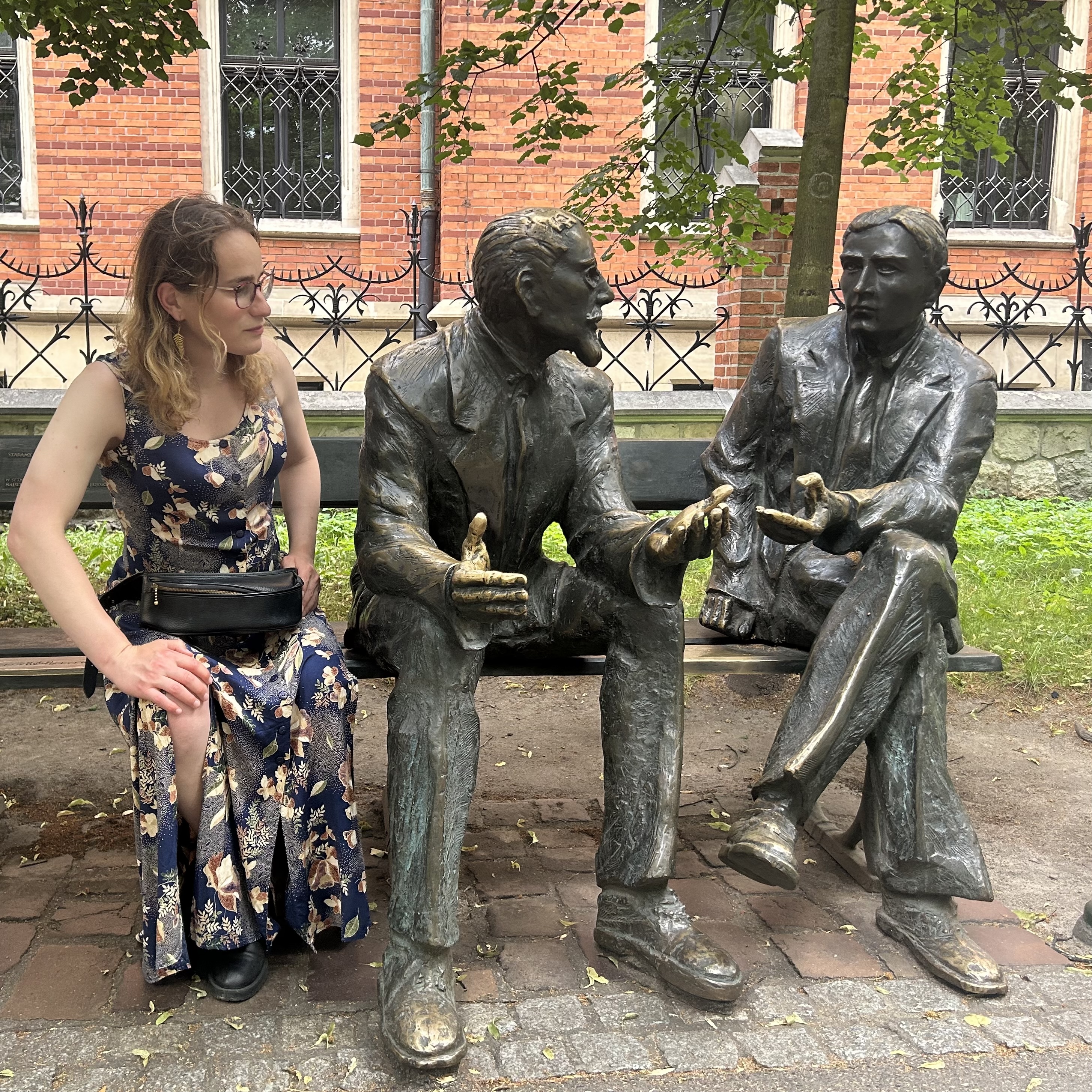 Deep in conversation with Stefan Banach and Otto Nikodym, Kraków, July 2026.
Photo by Marcin Sendera. Portrait chronically out of date.
How to address / refer to me
Name
Esmeralda for all purposes.
I was assigned a different name in the past, but it should not be used to refer to me except for archival and necessary clarification reasons. The change is explained on this page.
Pronouns
she or they
Contact
Communication is accepted in English, French, Russian, and occasionally other languages.
Address
Informatics Forum 2.27
10 Crichton Street
Edinburgh EH8 9AB
Scotland, UK
esmeralda [dot] whitammer [at] ed [dot] ac [dot] uk
Other profiles
GitHub and old GitHub
Google Scholar
Semantic Scholar
ORCID
My old website is archived here, if you really need to see it.
Math(s) Out Loud
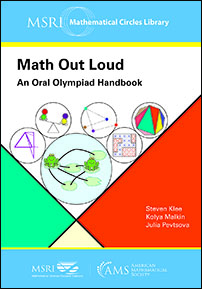
Available from the American Mathematical Society or Amazon.
What I do
Since July 2024: Chancellor's Fellow @ University of Edinburgh, School of Informatics
Since April 2025: Programme Fellow @ CIFAR, Learning in Machines and Brains
Expand for affiliation details
Member of Institute for Machine Learning (formerly Institute for Adaptive and Neural Computation)
Affiliate member of Institute for Language, Cognition and Computation
Affiliate member of Institute for Action, Perception and Behaviour
Generative AI Laboratory Fellow
ELLIS Member
Bayesian machine learning • neurosymbolic methods • ML for scientific reasoning
I study algorithms for probabilistic modelling and inference, as well as deep learning-based reasoning, and their applications.
Expand for some themes of my work
- Theoretically grounded probabilistic modelling algorithms, in particular, amortised Bayesian inference, induction of compositional structure in generative models, modelling of posteriors over high-dimensional explanatory variables (including with continuous-time (diffusion) generative models), and sampling structured, uncertainty-aware explanations for observed data.
- Applications to natural language processing and reasoning in language: what large language models can and cannot do and and how to overcome their limitations with improved inference procedures. I view human-like symbolic, formal, and mathematical reasoning via Bayesian neurosymbolic methods as a long-term aspiration for artificial intelligence.
- Applications to various scientific domains: notably, below you can find my (older) work on ML for remote sensing (land cover mapping and change detection), which can be used for tracking land use patterns over time and monitoring the effects of climate change, while more recent work on probabilistic inference for inverse problems in imaging has applications in astronomy, among other fields.
See here for a list of publications and invited talks.
Teaching
In the spring of 2026 I gave a course on Advanced Topics in Machine Learning, newly designed with Slava Borovitskiy and Rik Sarkar. My portion (deep generative modelling) was created with the help of assistants Kirill Tamogashev and Rajit Rajpal. Materials are available here.
In October-November 2024 I taught a mini-course on diffusion probabilistic models, largely coinciding with weeks 8-11 of the above course.
The prior distribution
Before moving to Edinburgh, I was a postdoc at Mila – Québec AI institute and Department of Informatics and Operations Research, Université de Montréal, where I was fortunate to work with Prof. Yoshua Bengio and also to collaborate with Profs. Aaron Courville, Gauthier Gidel, and Guillaume Lajoie, among others:
Expand for collaborators and students
I have also been lucky to work with many fellow postdoctoctoral researchers (including Kilian Fatras, Alex Hernández-García, Pablo Lemos, Alex Tong) and M.S./Ph.D. students and interns (including Tristan Deleu, Edward Hu, Moksh Jain, Minsu Kim, Salem Lahlou, Jarrid Rector-Brooks, Alexandra Volokhova, Dinghuai Zhang, among many others).
I was formally trained as a pure mathematician: at the University of Washington (B.S., 2015) and Yale University (M.S. and Ph.D., 2021). In addition, I believe many individuals and societies could benefit from a dose of friendly mathematical education. Some organizations I have been involved in: UW Math Circles (Seattle), Math-M-Addicts (New York City). I am also a coauthor of this collection of problems and puzzles.
Short bio in third person
Feel free to use the below if needed for talks and similar. Inappropriate uses are not welcome, including editing the text sua sponte to remove or change pronouns, avoiding use of my name, and questioning my identity mid-introduction. (All have happened. Really, do not do this.)
Esmeralda S. Whitammer is a Chancellor's Fellow in Informatics at the University of Edinburgh and a fellow of CIFAR's Learning in Machines and Brains programme. Her research focuses on algorithms for probabilistic inference and Bayesian machine learning, with applications in generative modelling, neurosymbolic methods, and machine reasoning. Within machine learning, Esmeralda's work explores modelling of Bayesian posteriors over high-dimensional and structured variables, induction and discovery of compositional structure in generative models, and neurosymbolic methods for uncertainty-aware reasoning in language and formal systems. Her work has found applications in pure and applied sciences, including inverse imaging, remote sensing, discovery of novel biological and chemical structures, and, most recently, robot control. Dr Whitammer holds a PhD in mathematics from Yale University (2021) and was previously a postdoctoral researcher at Mila – Québec AI Institute in Montréal (2021 to 2024).
Students
Current students
(Co-)primarily supervised research students:
- Kirill Tamogashev (PhD exp. 2028, with Siddharth N)
- Sanghyeok Choi (PhD exp. 2028, with Henry Gouk)
- Arran Carter (PhD exp. 2029; with Víctor Elvira, School of Mathematics)
- Brian Jauw (MSc exp. 2027)
Externally cosupervised research students:
- Siddarth Venkatraman (PhD exp. 2027, with Glen Berseth, Université de Montréal)
Secondarily supervised research students:
- Alex Gurung (PhD exp. 2026, with Mirella Lapata)
- Lena Zellinger (PhD exp. 2027, with Antonio Vergari)
- Rajit Rajpal (PhD exp. 2027, with Ben Leimkuhler, School of Mathematics)
- Yuanhao Jiang (PhD exp. 2029, with Ben Leimkuhler, School of Mathematics)
Taught MSc project supervisees:
- Shreyas Sai Ramakrishnan (MSc exp. 2026)
- Hassan Alshanqiti (MSc exp. 2026)
Other collaborating students:
Project interns:
- David Murray – probabilistic inference and causality under language model priors
- Michael Bolebrukh – formalisation of learning theory and ML-relevant mathematics
Past students
Long-term visitors:
- Vincent Pauline (from TU Munich), March-May 2026
Other collaborating students:
Prospective students
I am always looking for motivated students to fill fully-funded PhD positions in the School of Informatics, University of Edinburgh. Interested students should contact me to discuss research directions and the application processes for the various degree programmes that I can supervise. For international students, it is now too late to apply for entry in September 2026. Ideally, you should write before November 2026 to be considered for all available opportunities for entry in September 2027.
Expand for details
Research topics are in the areas of Bayesian machine learning (including probabilistic reasoning in language, generative models, and neurosymbolic methods) and applications in the sciences. I am especially happy to work with students who have a strong background in mathematics and an interest in robust and interpretable ML. Please see my research interests and recent publications for examples of the kind of work we might do together.
Studentships include:
- Funding for tuition and living expenses for the duration of the PhD, as well as discretionary travel and research funds and access to some of the most advanced computing facilities in Britain.
- A supportive and stimulating research environment in a large, leading institution in computer science and ML/AI – with particular strengths in NLP and probabilistic machine learning, as well as theoretical CS, robotics, and other areas.
- The opportunity to collaborate with researchers at other world-class institutions.
- A chance to explore one of the world's most beautiful, historic, and livable cities.
The typical length of a PhD in the UK is 3-3.5 years. All students have at least one secondary supervisor – please let me know if you have a specific person or lab in mind – and there are many opportunities for collaboration.
(I regret that I cannot engage in individual discussions with everyone who contacts me, despite my best intentions. If I do not respond, please remind me. However, I am unlikely to answer messages that are hallucinated by a language model, which account for an increasing number and help me to finetune my classifier of such messages, or messages that deadname/misgender me, a clear sign of not having read this page. No need for polished essays! I just want to know about you, your interests, and how you think we might work together.)
On diversity and inclusion
Diverse perspectives shape impactful research. If you have an unusual education history, come from an ethnic/cultural minority, or identify as a woman, non-binary person, or queer individual, and you are interested in working with me, I especially encourage you to apply and to mention this if you feel comfortable doing so.
I am committed to maintaining an inclusive environment for everyone I interact with and to considering ethics and fairness in both collaboration choices and research topics. I participate in and contribute to the activities of Women in Machine Learning and Queer in AI, groups that take direct action to reduce barriers to participation in our field.